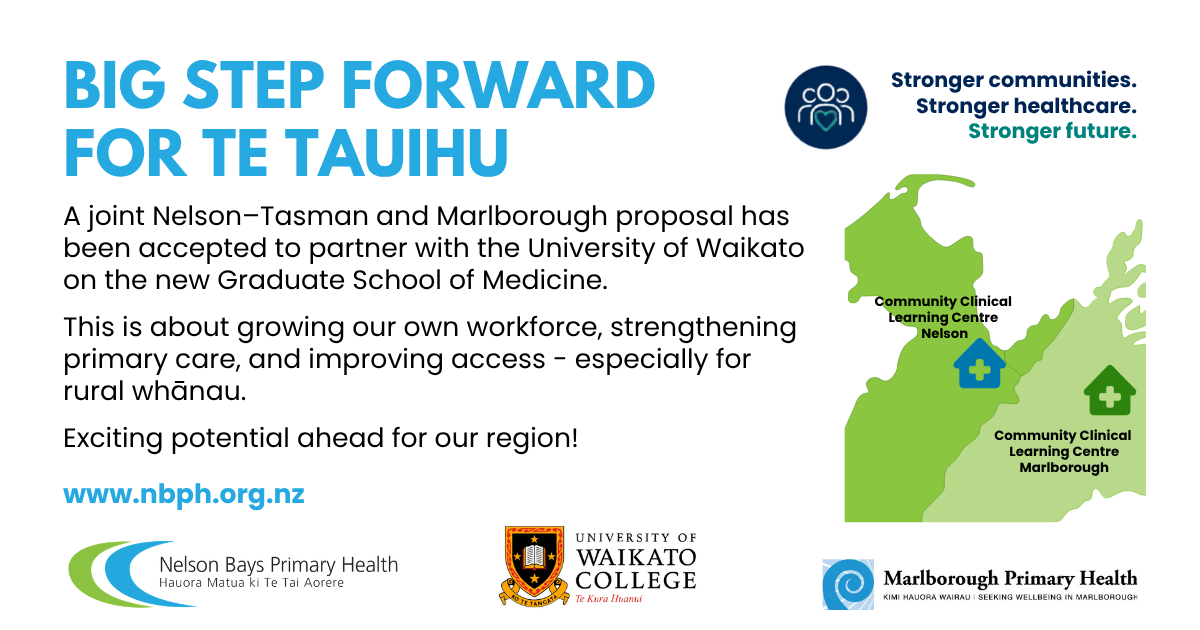
Te Tauihu secures partnership to establish New Zealand Graduate School of Medicine
Nelson Bays Primary Health (NBPH), Marlborough Primary Health, and Te Tauihu Iwi have successfully secured a partnership with the University of Waikato to establish the New Zealand Graduate School of Medicine, marking a significant step toward addressing workforce shortages and improving access to care across the region.
The successful proposal outlines a bold vision for community-based medical education grounded in local needs, strengthened through iwi partnership, and supported by the region’s established health and community networks.
Te Tauihu, encompassing Nelson-Tasman and Marlborough, serves a population of around 169,000 people. The region faces increasing demand from a rapidly ageing population, alongside persistent challenges in accessing primary care – particularly in rural and remote communities. Workforce shortages across general practice and community health services continue to impact access, continuity of care, and the sustainability of local services.
This new partnership will support the development of a strong pipeline of locally trained doctors who are connected to the communities they serve. Evidence shows that students who train in regional settings are more likely to remain and practise in those areas, supporting long-term workforce stability.
“This is about building a sustainable future workforce for our region,” said Sara Shaughnessy, Chief Executive of Nelson Bays Primary Health. “By training doctors here, in our communities, we increase the likelihood they will stay—and that is critical for improving access and outcomes for our whānau.”
The initiative places strong emphasis on partnership with iwi, recognising Te Tiriti o Waitangi as foundational to its design and delivery. Eight iwi across Te Tauihu supported the proposal.
Pouwhakahaere Te Rūnanga o Ngāti Rārua and Te Tauihu Iwi Bid representative Shane Graham says “Iwi welcome the opportunity to partner with the University of Waikato in establishing the New Zealand Graduate School of Medicine. This is a significant and genuinely exciting moment for the people — one that speaks directly to our collective aspirations for whānau wellbeing and equitable health outcomes across the Top of the South”.
A key component of the model is the development of Community Clinical Learning Centres (CCLCs) for both Tasman and Marlborough. These centres will act as hubs for teaching, research, and student support, embedded within local health systems and community networks.
Central to the proposal is a model of immersive, community-based training, where students spend extended time working in general practices, hospitals and community settings across Te Tauihu. The approach emphasises continuity of care, interprofessional learning, and cultural competence.
The initiative also creates wider regional benefits, including economic stimulation, increased research opportunities, and strengthened collaboration across health, education, and community sectors.
Both PHOs emphasise that while the region already has strong capacity and experience in hosting medical and health trainees, additional investment and support from the University will be essential to ensure sustainability—particularly in areas such as supervision, accommodation, and infrastructure.
“This is a long-term, partnership-based opportunity,” the proposal states. “It is about co-designing a system that reflects local aspirations and delivers meaningful benefits for communities.”
For more information contact media.enquiries@nbph.org.nz.