
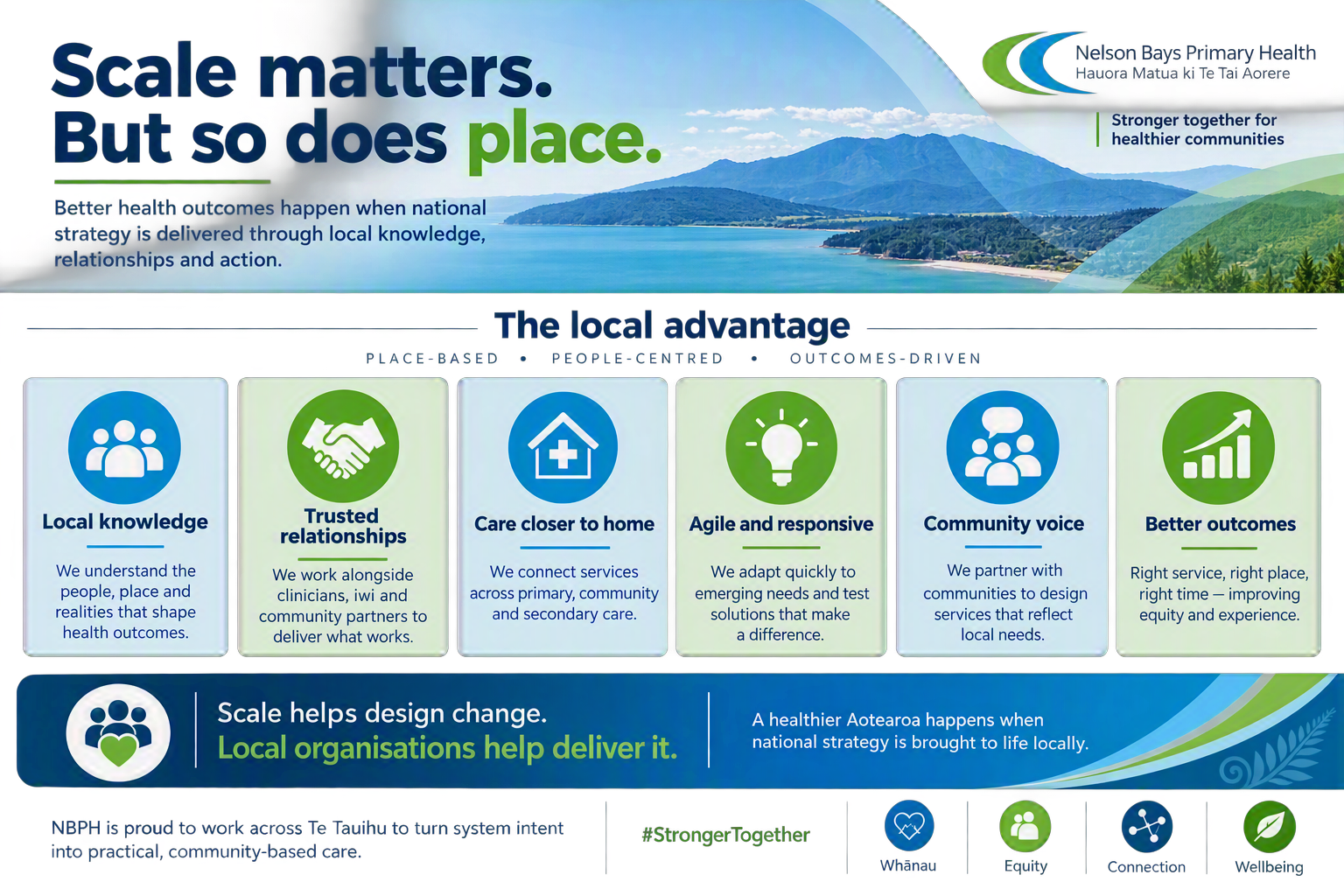
Scale matters. But so does place.
When we talk about improving health outcomes, reducing pressure on hospitals, and addressing inequities, how much of the solution comes from national design, and how much comes from local implementation?
The health sector often gravitates towards scale.
There are good reasons for that. Larger systems can support evidence-informed programme design, alignment with national health priorities, stronger data analytics, broader investment capability, and economies of scale. Well-designed national frameworks provide consistency, accountability, and an opportunity to maximise finite resources.
Those things matter.
But healthcare itself is not delivered at scale.
Healthcare happens in communities.
It happens in a general practice where clinicians know their patients, whānau, histories, and circumstances.
It happens when local providers, iwi, community organisations, general practice teams, and hospital services work together around the needs of a specific population.
It happens when people understand the realities of a place.
The drivers of health outcomes in Nelson Tasman are not identical to those in Auckland, Wellington, or Christchurch. Geography, demographics, workforce availability, deprivation patterns, transport challenges, housing, and community connections all influence whether services succeed or fail.
That is why local knowledge is key, and a strategic asset.
At NBPH, we see every day that the most effective solutions are often those that combine national intent with local understanding. National strategies can identify the "what". NBPH has a role in determining the "how".
The future health system needs both.
✅ National consistency, investment, and evidence-informed design
✅ Strong local and regional capability to translate strategy into action
The real question is not whether funding should sit with one institution or another. NBPH understands that decisions are informed by the best available understanding of need, impact, and what will work for the communities they are intended to serve.
When care can safely be delivered closer to home, whānau benefit.
When general practice, community providers, and specialist services operate as an integrated system, whānau benefit.
When local clinical leaders have the ability to adapt services around the realities of their population, whānau benefit.
And when organisations are trusted, connected, and accountable to the communities they serve, health outcomes improve.
Scale can help design and drive change.
But local organisations help deliver it.
At NBPH, we believe the future of healthcare is not a choice between scale and place. It is the combination of both.
Nationally, we need consistent direction, investment, and ambition.
Locally, we need organisations with deep community relationships, trusted clinical networks, and the agility to respond to changing needs.
NBPH provides that local advantage: the relationships, intelligence, clinical engagement, and implementation capability that turn regional and national strategy into meaningful community impact.
And while scale matters, place still matters too.
"The future health system will be strongest when national strategy and local knowledge work together. Scale creates opportunity. Place creates impact."
Read GPNZ’s Hauora 2036 publication here.
#PrimaryCare #HealthLeadership #GeneralPractice #NBPH #HealthEquity #LocalAdvantage